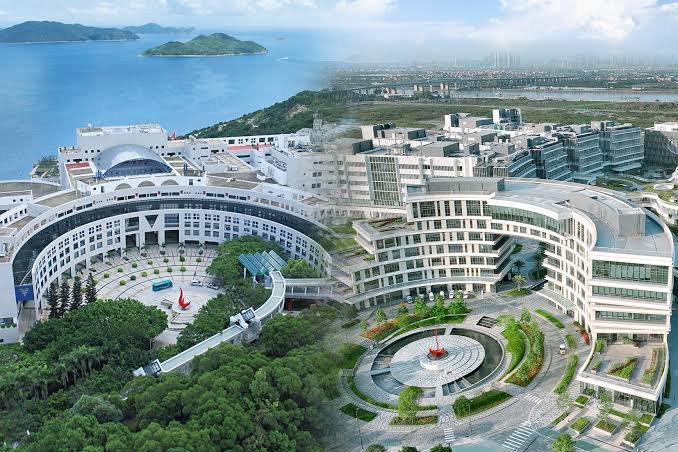
Introduction to the Hong Kong University of Science and Technology (HKUST)
Established in 1991, the Hong Kong University of Science and Technology (HKUST) has risen to global prominence as one of Asia’s premier research and teaching institutions. Operating on a 60-hectare hillside campus overlooking Clear Water Bay, HKUST was founded with a clear mandate: to advance economic and social development through research and education in science, engineering, business, and humanities.
Today, HKUST is recognized as a research-intensive university that emphasizes interdisciplinary education, internationalization, and entrepreneurial innovation. It serves as a major gateway connecting international academia to the dynamic Greater Bay Area (GBA).
Global Reputation and University Rankings
Despite its relatively short history, HKUST consistently secures high placements in international university rankings, particularly among young institutions:
- QS World University Rankings: HKUST ranks 44th globally in the QS World University Rankings 2026.
- QS Asia University Rankings: It sits at 6th place in Asia and is the second-highest ranked university in Hong Kong for 2026.
- Times Higher Education (THE) Young University Rankings: Consistently placed among the world’s top 3 young universities.
- THE Impact Rankings: Ranked 19th worldwide and No. 1 in Hong Kong in 2025, underscoring its commitment to sustainability and social impact.
- Global Employability University Ranking: Its graduates are regularly recognized among the top 30 most sought-after employees worldwide.
Academic Structure and Faculties
HKUST operates under a dynamic School-based structure that encourages interdisciplinary collaboration across foundational and applied fields.
School of Science (SSCI)
The School of Science covers core scientific disciplines including Life Science, Mathematics, Physics, Chemistry, and Ocean Science. It is recognized for breakthrough discoveries in molecular neuroscience, structural biology, and quantum materials.
School of Engineering (SENG)
As HKUST’s largest school, SENG encompasses Chemical and Biological Engineering, Civil and Environmental Engineering, Computer Science and Engineering, Electronic and Computer Engineering, Industrial Engineering and Decision Analytics, and Mechanical and Aerospace Engineering. In QS subject rankings, SENG programs—particularly Data Science, Artificial Intelligence, and Computer Science—rank among the top 50 worldwide.
School of Business and Management (HKUST Business School)
The HKUST Business School is one of the most prestigious business schools in Asia, accredited by both AACSB and EQUIS. It offers world-renowned MBA, EMBA, and undergraduate business programs, frequently partnering with institutions like the Kellogg School of Management for joint executive education.
School of Humanities and Social Science (SHSS)
SHSS provides a vital liberal arts foundation to HKUST’s science and business curricula. Its research strengths lie in Chinese economic history, quantitative social science, linguistics, and global political economy.
Academy of Interdisciplinary Studies (AIS)
The AIS bridges traditional academic silos by offering programs in Public Policy, Sustainability, Technology and Management, and Individualized Interdisciplinary Majors, addressing complex real-world challenges such as climate resilience and energy transition.
Admissions Guide
HKUST adopts a holistic, competitive admissions process for local, Mainland Chinese, and international students.
Undergraduate Admissions Requirements
Applicants holding international qualifications apply directly through HKUST’s online admission system:
- Academic Qualifications: Standardized high school curricula are accepted, including the International Baccalaureate (IB Diploma), GCE A-Levels, SAT/AP, ACT, and regional secondary school examinations.
- English Language Proficiency: Non-native speakers must demonstrate proficiency through IELTS (typically a minimum overall band of 6.5), TOEFL iBT (minimum score of 80), or equivalent qualifications in accepted high school curricula.
- School or Program-Based Entry: Students can apply for School-based entry (undeclared major for the first year) or direct Program-based entry for specific specializations.
Postgraduate Admissions Requirements
For research-taught (MPhil/PhD) and coursework-taught (MSc/MA/MBA) programs:
- Academic Standing: A recognized bachelor’s degree with a strong academic record (typically second class honors upper division or a GPA equivalent of 3.0/4.0 and above).
- Standardized Tests: GMAT or GRE scores are mandatory or highly recommended for business programs and quantitative finance.
- Research Proposal: MPhil and PhD candidates must submit a formal research proposal and secure support from a prospective faculty supervisor.
Application Deadlines and Entry Rounds
The university operates rolling admission cycles with designated deadlines:
- Early Round: Typically closes in mid-November of the preceding year (ideal for international students seeking early decisions and scholarships).
- Main Round: Typically closes in early January.
- Late/Rolling Applications: Evaluated on a space-available basis through spring and summer.
Tuition Fees, Financial Aid, and Scholarships
Tuition and Living Expenses (2025–2027)
Tuition fees depend on the student’s origin and level of study:
- Local Undergraduates: Highly subsidized by the Hong Kong government, costing approximately HKD 42,100 to HKD 47,000 per year.
- International & Mainland Undergraduates: Range from approximately HKD 140,000 to HKD 215,000 (~USD 18,000–28,000) per academic year, depending on the entering cohort and fee updates.
- Postgraduate Programs: Research programs (MPhil/PhD) typically charge around HKD 42,100 per year. Self-financed taught master’s (MSc) programs vary widely between HKD 120,000 and HKD 300,000+ depending on the specialization.
- Living Costs: Accommodation, food, and personal expenses in Hong Kong average around HKD 60,000 to HKD 80,000 (~USD 7,700–10,300) annually.
Scholarships and Funding Opportunities
HKUST offers comprehensive financial aid packages to attract global talent:
- University Admissions Scholarships: Awarded automatically based on academic merit upon application; grants range from partial tuition waivers to full tuition plus living allowances.
- Hong Kong PhD Fellowship Scheme (HKPFS): An elite government scholarship offering a monthly stipend, conference travel allowances, and excellence awards for top-tier international PhD candidates.
- Postgraduate Studentships (PGS): Standard financial support provided to qualified full-time MPhil and PhD students to cover tuition and daily living expenses.
Research Excellence and Innovation Centers
Research is the cornerstone of HKUST, with over 80% of its research work rated as “internationally excellent” or “world leading” in Hong Kong’s University Grants Committee Research Assessment Exercises.
State Key Laboratories and National Centers
HKUST hosts prestigious research institutes supported by the Ministry of Science and Technology of China:
- State Key Laboratory of Nervous System Disorders: Pioneering molecular neuroscience, brain aging, and drug discovery for neurological diseases like Alzheimer’s.
- State Key Laboratory of Displays and Opto-Electronics: Advancing next-generation visual displays, sensors, and light-emitting devices.
- State Key Laboratory of Climate Resilience for Coastal Cities: Spearheading solutions in sustainable urban infrastructure and environmental protection.
- Chinese National Engineering Research Centers (CNERCs): Includes centers dedicated to Tissue Restoration & Reconstruction and the Control & Treatment of Heavy Metal Pollution.
HKUST(Guangzhou) and the Unified Campus Framework
Opening its doors in Nansha, Guangzhou, HKUST(GZ) operates under the “Unified HKUST, Complementary Campuses” framework. While the Clear Water Bay campus focuses on traditional academic faculties, HKUST(Guangzhou) features a cross-disciplinary structure built around four hubs:
- Function Hub: Advanced Materials, Earth, Ocean & Atmospheric Sciences, Microelectronics, Sustainable Energy.
- Information Hub: AI, Data Science & Analytics, Internet of Things, Computational Media.
- Systems Hub: Bioscience & Biomedical Engineering, Intelligent Transportation, Robotics & Autonomous Systems, Smart Manufacturing.
- Society Hub: Financial Technology, Innovation Policy & Entrepreneurship, Urban Governance & Design.
Entrepreneurship and Knowledge Transfer
HKUST maintains an aggressive knowledge-transfer ecosystem designed to transition laboratory discoveries into commercial enterprises:
- Startup Output: Members of the HKUST community have founded over 1,900 active start-ups, including 11 Unicorns and 22 successful exits via IPOs or mergers. Prominent alumni-founded companies include DJI (the world’s leading consumer drone manufacturer).
- HKUST Technology Transfer Center (TTC): Manages patent portfolios, licensing, and industry collaboration across global markets.
- HKUST Entrepreneurship Center (EC): Provides incubation support, mentorship, and seed funding through competitions such as the HKUST-Sino One Million Dollar Entrepreneurship Competition.
Campus Life and Student Resources
The Clear Water Bay campus provides a self-contained academic community equipped with world-class facilities:
- Lee Shau Kee Library: A central academic hub offering extensive digital collections, study spaces, and scenic ocean views.
- Residential Halls: On-campus housing available for undergraduate and postgraduate students, divided into traditional halls and living-learning communities.
- Athletic and Recreational Facilities: Includes an indoor seafront swimming pool, artificial turf soccer pitch, tennis courts, climbing walls, and multipurpose sports halls.
- Student Societies: Over 100 student-run organizations covering cultural, academic, sports, and community service interests, fostering an international student experience.